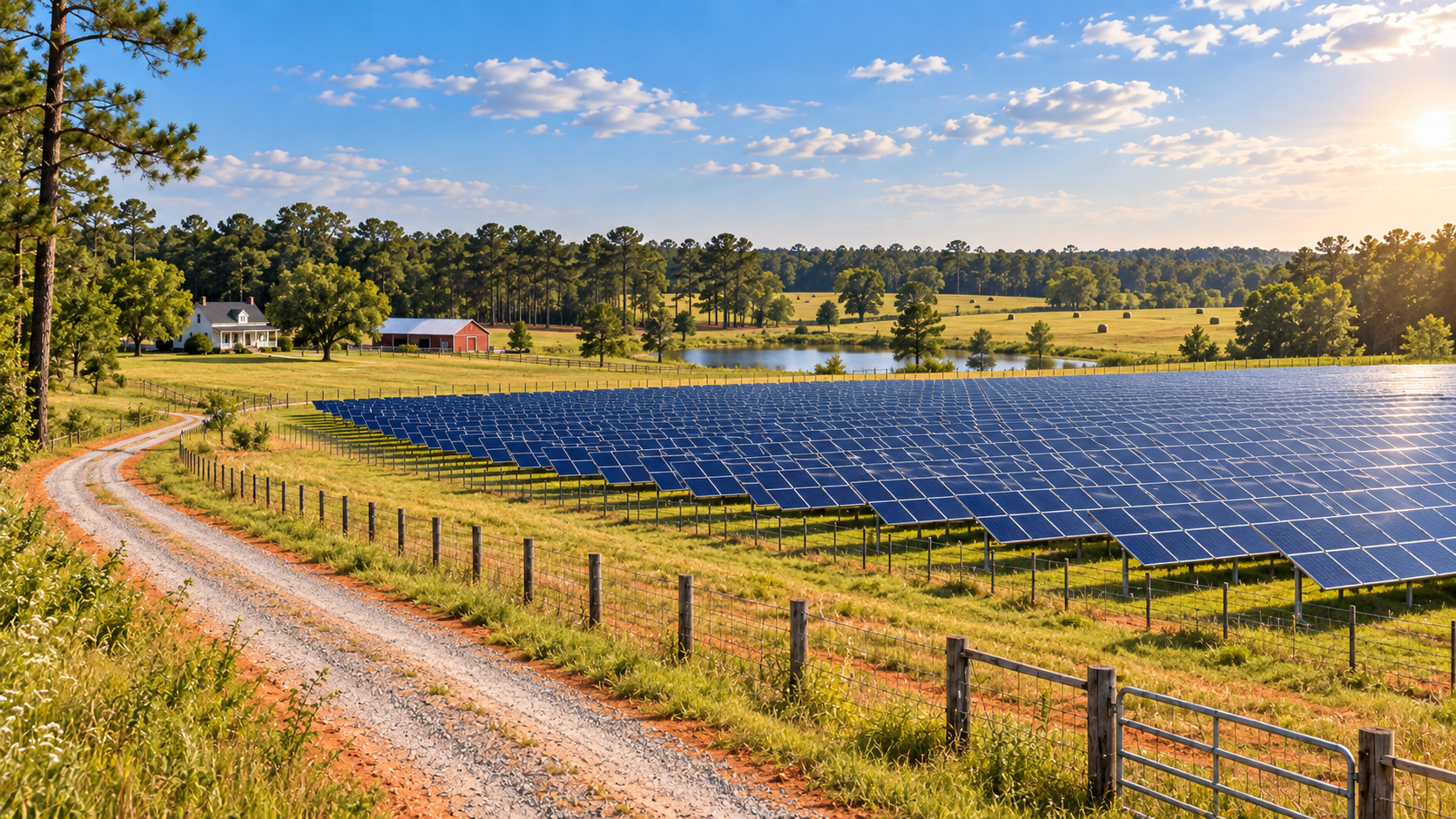
As demand for electricity continues to grow, renewable energy development has created additional opportunities for some Georgia landowners.
One of the most significant involves leasing property for solar energy production.
In certain locations, solar developers may be interested in leasing farmland, pasture, or other suitable acreage to construct large solar installations. These agreements can provide long-term rental income without requiring the landowner to personally invest in solar equipment.
However, not every property is suitable for solar development, and entering a long-term lease can have substantial consequences for the land’s future use.
Understanding the available opportunities, development requirements, financial considerations, and potential risks is essential before committing your property to an energy project.
Solar land leases are among the most practical renewable energy opportunities for Georgia property owners.
Under a typical arrangement, a solar developer leases a portion of the property to construct and operate a solar energy facility.
The developer generally arranges financing, installation, maintenance, and the sale of electricity.
In exchange, the landowner receives rental payments according to the lease agreement.
These payments are often based on the acreage being leased rather than the actual electricity generated.
For owners of agricultural or undeveloped property, a solar lease may create an income opportunity that differs considerably from traditional farming or timber production.
However, solar leases are long-term commitments. Agreements may run for several decades, including potential extension periods.
During that time, the leased acreage may be unavailable for other uses.
Before entering an agreement, it’s important to consider both the proposed income and the opportunities that could be lost by committing the property to solar development.
One of the most important factors in determining solar development potential is the property’s location relative to existing electrical infrastructure.
A tract with excellent sunlight and relatively level ground may still be unsuitable if connecting the project to the electrical grid would be prohibitively expensive.
Solar developers generally evaluate several characteristics:
Properties with large, relatively level, open areas may offer advantages because they can require less clearing and site preparation.
However, the amount of acreage needed varies significantly according to the size and type of solar project.
A smaller installation may use only a portion of a property, while a utility-scale facility may require hundreds of acres.
It’s also important to understand that the presence of nearby power lines doesn’t guarantee that a project can be connected economically.
Utility approval, engineering studies, and available grid capacity can ultimately determine whether a project is feasible.
Many solar development proposals begin with an option agreement rather than an immediate long-term operating lease.
An option allows a developer to investigate the property and determine whether a project is feasible before committing to construction.
During this period, the developer may conduct engineering studies, evaluate electrical interconnection, seek permits, and negotiate arrangements for selling the electricity.
The landowner may receive option payments while the developer completes this work.
However, option payments are often considerably smaller than the rent payable once an operating lease begins.
There is also no guarantee that the developer will ultimately construct the project.
This creates an important consideration for property owners.
A lengthy option agreement may restrict the ability to sell, develop, or lease the property for other purposes while producing relatively little income.
Before signing, landowners should understand how long the option lasts, what restrictions apply during that period, whether extensions are permitted, and what compensation will be received.
The financial attractiveness of a solar proposal should be evaluated across the entire agreement, not simply by looking at the projected operating rent.
Solar lease compensation can vary considerably based on location, acreage, electrical infrastructure, developer demand, and the terms being negotiated.
A property near suitable grid infrastructure may attract greater interest than an otherwise comparable tract with expensive interconnection requirements.
Lease structures also differ.
Some agreements provide a fixed annual payment per acre, while others contain periodic rent increases or other negotiated provisions.
When evaluating a proposal, landowners should consider more than the initial rental rate.
Important questions include:
A solar lease can potentially generate substantially more annual income than certain traditional agricultural arrangements.
However, the financial comparison should include lost agricultural or timber income, property-tax changes, restrictions on future development, and the long-term effect on the property’s marketability.
A higher annual rental payment doesn’t necessarily mean the solar lease creates the greatest total value.
Instead of leasing land to a developer, some property owners may consider purchasing and operating a solar installation themselves.
This approach involves substantially different economics.
The landowner or business generally assumes responsibility for financing, construction, equipment, insurance, maintenance, and operating costs.
Potential financial benefits may come from reducing electricity purchases or selling power through an approved utility arrangement.
Georgia Power offers several solar programs, including arrangements through which qualifying facilities can sell electricity to the utility.
However, project eligibility, interconnection requirements, available program capacity, and compensation rates vary.
A power purchase agreement, commonly called a PPA, is a contract governing the sale of electricity under agreed terms.
This is different from a land lease.
A landowner who simply leases acreage to a solar developer generally isn’t the party selling electricity to the utility.
For individuals considering owning a solar facility, detailed financial projections are essential.
Installation expenses, financing, operating costs, utility compensation, equipment replacement, and future maintenance can all materially affect the return.
For most landowners who primarily want rental income without operating an energy business, leasing suitable property to an established developer may be the simpler approach.
Not every solar project needs to generate direct rental income.
For certain farms, rural businesses, and residential properties, solar equipment may be used to reduce electricity expenses.
Potential applications include powering irrigation equipment, agricultural facilities, workshops, and other electrical loads.
The financial benefits depend heavily on how much electricity the property consumes and when that electricity is needed.
For example, a business that uses considerable electricity during daylight hours may be able to consume more of its solar production directly.
Excess electricity exported to the grid may receive a different rate of compensation.
In Georgia Power’s service territory, the available solar programs have specific eligibility and compensation requirements.
Other electric utilities and cooperatives may have different policies.
Owners should obtain actual utility information and evaluate projected savings before purchasing equipment.
The most financially attractive system isn’t necessarily the one that produces the greatest amount of electricity. It’s the system whose production, cost, and utility arrangements provide the strongest economic benefit.
Although solar receives much of the attention in Georgia, other renewable energy technologies may provide opportunities under particular circumstances.
Wind energy is one example.
However, large-scale wind development has generally been less prevalent in Georgia than solar development.
The economics depend on dependable wind speeds, suitable turbine locations, infrastructure, and access to electricity markets.
A property owner considering wind generation should have its actual wind resource evaluated rather than assuming that an open field or elevated location is sufficient.
Other possibilities may include biomass or biogas production associated with certain agricultural operations.
For example, a large livestock operation may have access to organic materials that could potentially support specialized energy production.
These projects generally require substantial infrastructure, dependable feedstock, technical expertise, and an appropriate market for the resulting energy.
They are not typical passive-income opportunities for owners of undeveloped acreage.
For most Georgia landowners exploring renewable energy income, solar development is likely to be the most relevant starting point.
Tax treatment can significantly affect the economics of renewable energy development.
Georgia offers preferential property-tax assessments for certain qualifying agricultural and forestland properties.
One example is Conservation Use Value Assessment, commonly called CUVA.
However, converting a portion of qualifying property to solar energy production can affect its tax treatment.
Georgia law provides a mechanism for removing qualifying solar-development acreage from an existing CUVA covenant, but the removed acreage becomes subject to different assessment treatment and applicable penalties.
This is an important issue to address before executing a solar agreement.
Landowners should also distinguish between incentives available to a solar facility owner and benefits available to someone who only leases land.
Federal energy tax credits, when available, generally depend on the party making the qualifying investment and meeting the applicable requirements.
The landowner doesn’t automatically receive those benefits simply because solar equipment is installed on the property.
Because energy incentives and utility programs change, financial projections should rely on current eligibility requirements rather than assuming that historical tax credits or grants remain available.
A long-term solar agreement can affect a property for decades, making the lease terms particularly important.
While rental income is attractive, landowners should consider how construction and operation may affect the remaining property.
Potential concerns include clearing existing timber, removing topsoil, changing drainage patterns, constructing roads, limiting access, and interfering with neighboring agricultural or recreational uses.
The agreement should clearly address the developer’s responsibilities for those impacts.
Decommissioning is another important issue.
Eventually, solar panels and associated equipment may need to be removed and the property restored.
Georgia has established requirements addressing the removal of solar equipment and financial assurance for qualifying solar facility agreements.
However, the specific contractual protections remain important, including applicable provisions governing removal obligations, financial security, assignment of the lease, and restoration standards.
A landowner should also evaluate what happens if the developer sells the project or experiences financial difficulties.
Before entering a long-term agreement, consulting an attorney experienced in Georgia solar development and commercial land leases can help protect the owner’s financial and property interests.
Renewable energy development should be evaluated as one potential use of land rather than automatically assuming it is the most profitable.
A tract suitable for solar development may also have value for agriculture, timber production, recreation, or future residential development.
For example, farmland near an expanding community may possess development potential that could eventually exceed the value of a long-term solar lease.
Likewise, a productive timber tract may contain merchantable timber that would need to be removed before solar construction could begin.
The value of that timber should be considered when evaluating the proposed arrangement.
Other properties may have limited alternative uses, making a solar lease particularly attractive.
The important comparison is between the net financial benefits of each realistic alternative.
This includes anticipated income, upfront and ongoing expenses, taxes, restrictions, capital requirements, and eventual property value.
A solar lease that generates attractive income while preserving appropriate protections and flexibility may offer a compelling opportunity.
However, it should be judged against the property’s other potential uses rather than evaluated in isolation.
Solar energy development can provide meaningful income opportunities for certain Georgia landowners.
However, the suitability of a property depends on more than available acreage and sunlight.
Electrical infrastructure, local regulations, development costs, market demand, and lease terms all influence whether a project is feasible.
For property owners approached by solar developers, understanding the option agreement, long-term compensation, tax consequences, and restrictions on future land use is essential.
At Mathis Land Group, we understand that rural property can offer multiple sources of value, from agricultural production and timber to recreation and future development.
Whether you’re evaluating the sale of property with energy-development potential or considering how a proposed long-term lease may affect your land, understanding the broader real estate implications is an important part of making an informed decision.
Considering buying or selling Georgia land with renewable energy potential? Contact Mathis Land Group to discuss your property and available opportunities.